
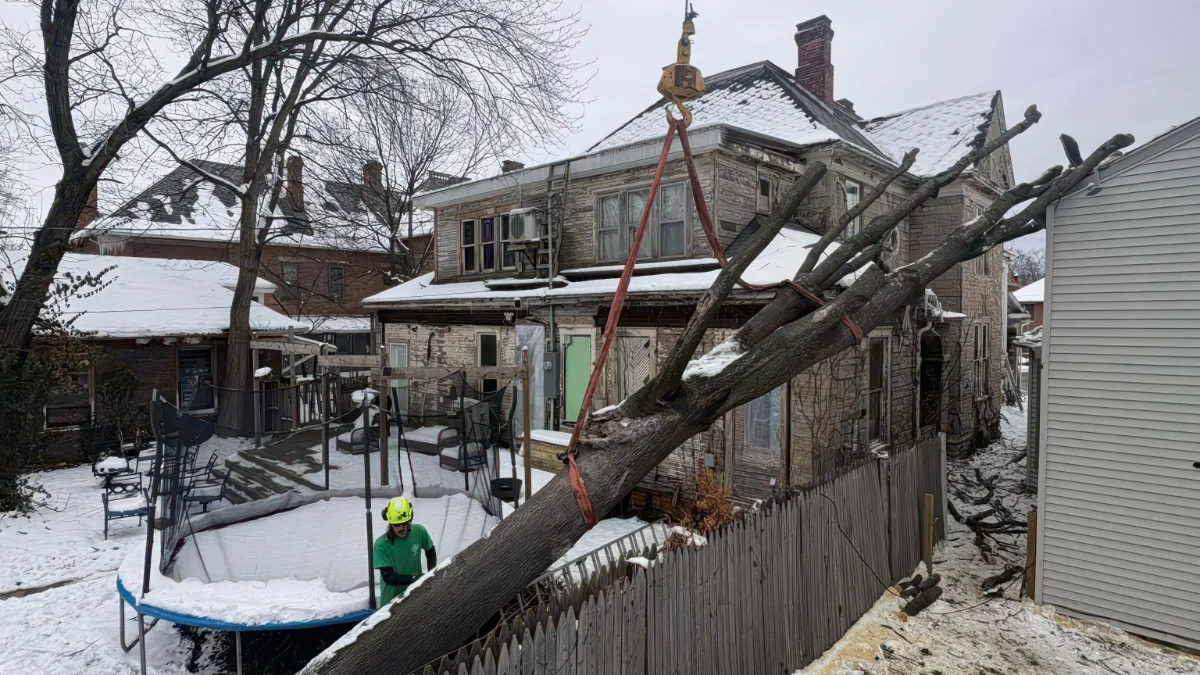
After a spring storm rolls through Central Ohio, knowing the dangerous tree signs after spring storms Ohio homeowners should watch for could be the difference between catching a problem early and dealing with a catastrophe. Most people walk outside, do a quick scan, and if the tree is still standing, they move on with their day. That assumption is understandable. It’s also genuinely dangerous.
The trees that hurt people aren’t always the ones that look wrecked. Sometimes they look totally normal. But underneath the surface, or hidden up in the canopy, something has already failed.
Why Ohio’s Spring Storm Season Is Different
Ohio sits in a weather corridor that gets hit hard from March through June. You’re dealing with severe thunderstorms, straight-line winds that can exceed 70 mph, occasional tornadoes, and in early spring, ice storms that add massive weight to branches that are just starting to bud out. According to NOAA’s Storm Events Database, Ohio consistently ranks among the top states for damaging wind events, with hundreds of recorded incidents each year causing property damage and injuries. These aren’t rare freak events. They’re expected.
What makes spring specifically dangerous is the combination of factors hitting at once. The soil is already saturated from weeks of spring rain. Trees are leafing out, which means they have more surface area catching wind than they do in winter. And here in Central Ohio, Pickaway County and the surrounding area sit on clay-heavy soils that hold water like a sponge. When that clay gets fully saturated, root anchorage drops dramatically. A tree that could normally handle 60 mph winds might fail at 40 mph when the ground is waterlogged.
The Scioto River corridor, along with tributaries like Deer Creek and Paint Creek, creates additional flood-prone zones where soil saturation after a major storm can be extreme. If you live anywhere near those waterways in Circleville, Chillicothe, or the communities in between, this matters to you directly.
Sign 1: Cracks or Splits in the Trunk or Major Limbs
A crack in a tree’s trunk that wasn’t there before the storm is a serious structural failure indicator. It’s not cosmetic. It means the wood has actually separated under load, and that damage doesn’t heal itself. Even a small crack can grow quickly under normal wind conditions, especially if the tree gets hit by another storm before anyone addresses it.
Pay close attention to trees with co-dominant stems. That’s the term arborists use when a tree has two main trunks of roughly equal size growing up from the same point. The attachment between those stems is inherently weak because the wood fibers grow outward instead of interlocking cleanly. These trees are some of the first to split in high winds. If your tree looks like a giant Y and you notice any separation or cracking at that junction after a storm, take it seriously.
Vertical cracks running down the main trunk are especially alarming. A horizontal crack might indicate a branch failure, which is bad enough. But a vertical crack in the main trunk can mean the entire tree’s structure is compromised.
Sign 2: Hanging or Partially Attached Branches
These are called widow makers, and the name isn’t dramatic. It’s accurate. A branch that broke during the storm but is still hanging in the canopy, held by bark or a few wood fibers, can fall days or weeks later with zero warning. And because they’re often 30 or 40 feet up, they’re carrying serious momentum by the time they hit the ground.
The tricky part is that widow makers are hard to see from the ground. You have to actually look up into the canopy, not just glance at the tree from your back door. Walk around the tree slowly and look for branches that are angled wrong, dangling, or hanging against other branches. (Take a pair of binoculars if you have them. It makes a real difference when you’re trying to see into a dense spring canopy.)
Any hanging branch positioned over a driveway, walkway, play area, patio, or roof is a priority. Don’t wait on those. Don’t walk under them while you’re deciding what to do.
Sign 3: Soil Heaving or Exposed Roots at the Base
If the ground around the base of your tree looks raised, cracked, or uneven, and if you can see roots that weren’t poking up before the storm, the root system is actively failing. The tree is beginning to tip over. It may look perfectly stable from five feet away, but the process has already started.
This is particularly common in Central Ohio’s clay soils after heavy spring rain. That saturated clay essentially becomes slippery, and the roots lose their grip. A large oak or silver maple that’s been standing for 50 years can begin to uproot in a matter of hours during a major storm. The fact that it’s still standing doesn’t mean it’s safe.
A tree showing any root heave needs to be looked at right away. Not next week. Right away.
Sign 4: A New Lean That Wasn’t There Before
Here’s an important distinction that trips people up. Lots of trees have a natural lean that’s been there for years. That lean developed slowly as the tree grew toward light, and the root system compensated for it over time. That kind of lean is usually stable.
A new lean that appeared after the storm is different. It means root failure has occurred on one side, and the tree is now shifting its weight toward the direction it’s leaning. If that lean is pointing toward your house, a power line, a fence, or anywhere people spend time, that’s a priority concern.
Sometimes the new lean is subtle. That’s why it’s worth looking at photos you’ve taken of your yard in the past, or even Google Street View images, to compare what the tree looked like before the storm.
Sign 5: Bark Damage, Gouges, or Lightning Strikes
Flying debris during a storm can strip bark off trunks and branches, leaving open wounds that invite disease, fungal infection, and insects. Bark damage on major limbs is a concern. Bark damage on the main trunk is more serious because it affects the tree’s ability to move water and nutrients.
Lightning strikes deserve special attention. Ohio has high lightning strike frequency, especially from late spring through summer. A lightning-struck tree often shows a distinctive spiral stripe of stripped or exploded bark running down the trunk. Here’s the thing: that tree might look completely alive for months after the strike. The leaves might even come back in spring. But the internal damage is done, and as the tree dies from the inside out, it becomes increasingly hazardous.
If you see that spiral stripe pattern on a tree, get it professionally assessed. Don’t wait to see if it recovers.
Sign 6: Crown Dieback or Sudden Leaf Drop After the Storm
This one shows up late, which is exactly why it catches people off guard. Two to four weeks after a storm, you might notice that a section of your tree’s canopy that had leaves is now bare, or the leaves in that section are wilting and turning brown while the rest of the tree looks fine. That’s the tree telling you it can no longer move water to that part of the canopy.
The cause is usually root damage or internal vascular damage that happened during the storm. The tree used up whatever water was stored in the affected branches, and now it can’t replace it. In Ohio, the tree species most vulnerable to this kind of delayed dieback include silver maple, cottonwood, white ash (which is already under stress from the emerald ash borer), and American elm.
If you’re seeing patchy crown dieback a few weeks after a major storm, don’t dismiss it as normal seasonal leaf drop. It’s a symptom worth investigating.
Sign 7: The Tree’s Location Relative to Structures and People
Risk isn’t just about how damaged a tree is. It’s about what happens if it falls. A tree with minor storm damage sitting in an open field well away from anything is a low-priority situation. The same tree with the same minor damage positioned directly over your roof, over a power line, or over the area where your kids play is a completely different situation.
Central Ohio homeowners should always think about what’s in the fall zone when they’re assessing storm-damaged trees. That means the full length of the tree in every direction it could potentially fall. For a 60-foot tree, that’s a 60-foot radius. You’d be surprised how much of a typical residential lot that covers.
What Not to Do After a Storm
Don’t try to pull down or cut hanging branches yourself. Widow makers are unpredictable. They can shift as soon as you touch them, or as soon as you cut a branch nearby. This is genuinely one of the most dangerous things a homeowner can attempt.
Don’t assume the tree is fine just because it’s still standing. Don’t wait months to have it looked at, either. Storm damage weakens trees structurally, and a tree that survived this storm in a compromised state is more vulnerable to the next one. Spring storm season in Ohio runs through June, so there may not be much time between events.
If you see any of the signs described above, the right call is to get a professional set of eyes on it. G2G Tree Service’s emergency tree services are available for situations that can’t wait, and a professional tree assessment from G2G Tree Service is free and comes with no pressure or obligation. If you want to learn more about G2G Tree Service’s storm damage cleanup services, that information is available on their website.
For additional context on how frequently Ohio gets hit by damaging storms, you can browse the data directly at NOAA’s Storm Events Database, which tracks storm events by state and county going back decades.
Frequently Asked Questions
How do I know if my tree is dangerous after a spring storm in Ohio?
Look for the signs that often get missed: cracks in the trunk, hanging branches up in the canopy, soil heaving at the base, a new lean that wasn’t there before the storm, bark damage or lightning strike patterns, and delayed browning in sections of the canopy two to four weeks after the storm. A tree can look perfectly normal from 20 feet away and still be actively failing. At G2G Tree Service, we serve homeowners across seven counties in Central Ohio, including Pickaway, Fairfield, Franklin, and Ross Counties, and we see these hidden failure signs regularly after major spring storms. If you’re not sure, the safest thing you can do is get a professional opinion before assuming it’s fine. We offer free assessments, so there’s no cost to getting a second set of eyes on it.
Is a leaning tree always dangerous?
Not always. Plenty of trees have a natural lean that’s been there for years and is completely stable because the root system grew to compensate for it over time. The concern is a new lean that developed during or after a storm. That’s a sign that root failure has occurred on one side, and the tree’s weight is shifting. At G2G Tree Service, we work with homeowners across Central Ohio, from Circleville and Columbus down to Chillicothe and Lancaster, and a new post-storm lean toward a structure or occupied area is one of the things we take most seriously during an assessment. If you’re not sure whether your tree’s lean is new or old, compare it to old photos of your yard. That comparison can tell you a lot.
What are widow makers and why are they so dangerous?
Widow makers are branches that broke during a storm but are still hanging in the canopy, attached by bark or a small amount of wood fiber. They’re dangerous because they can fall days or weeks after the storm with no warning, and they’re often not visible from the ground without looking up into the canopy carefully. A branch that’s 30 or 40 feet up carries serious force by the time it hits the ground. G2G Tree Service handles widow maker removal regularly throughout our seven-county service area in Central Ohio, including in neighborhoods in Grove City, Bexley, and communities around Pickaway County. Do not attempt to pull these down yourself. The branch can shift and fall the moment anything around it is disturbed.
Why do Ohio’s spring soils make storm tree damage worse?
Central Ohio, especially Pickaway County and the surrounding area, has clay-heavy soils that hold water much longer than sandy or loamy soils. After heavy spring rain, that clay becomes saturated and loses its ability to anchor tree roots effectively. A tree that could normally withstand 60 mph winds might uproot at 40 mph when the ground is waterlogged. Areas near the Scioto River and its tributaries, including Deer Creek and Paint Creek, are especially prone to extreme soil saturation after major storms. G2G Tree Service has been working in these soil conditions across Central Ohio for over 10 years, and we see root failure and soil heaving in these areas far more often than homeowners expect. If you’re in a flood-prone area and you’ve just had a major storm, checking for root heave at the base of your trees is worth doing even if the tree looks fine from above.
How soon should I have a storm-damaged tree assessed?
As soon as you can, honestly. Ohio’s spring storm season runs from March through June, and a tree that’s been structurally weakened by one storm is more vulnerable to the next one. Waiting a few months to get an assessment means that tree is sitting in a compromised state through the rest of the active storm season. G2G Tree Service offers free tree health assessments to homeowners throughout our seven-county service area in Central Ohio, including Fairfield, Fayette, Franklin, Hocking, Madison, Pickaway, and Ross Counties. There’s no cost to having someone come out and look, and the peace of mind is worth it. If the tree is fine, we’ll tell you that. If it’s not, you’ll know before the next storm rolls through.
The trees in your yard are living structures, and like any structure, they can fail after enough stress. Understanding what to look for after a spring storm gives you the ability to catch problems before they become emergencies, which is almost always better for your safety, your property, and your wallet.
Not Sure If Your Tree Is Safe After a Storm?
G2G Tree Service provides FREE estimates and tree health assessments across 7 counties in Central Ohio, including Pickaway, Fairfield, Franklin, Fayette, Hocking, Madison, and Ross Counties. Visit g2gtreeservice.com to schedule your assessment.